Weed out the need-less
redundant (adj.): (especially of a word, phrase, etc.) unnecessary because it is more than is needed. (https://dictionary.cambridge.org/dictionary/english/redundant)


If you enjoy chips or biscuits, I bet you like them crispy. The same is true for sentences. If you tend to use words or phrases that fill the sentence but do not advance your argument much, the reader will feel like chewing soggy fries or cookies.
Here’s a word to the wise: Expunge, edit out, eliminate and scratch the entire set of verbal expressions whose necessity is not satisfactorily warranted by the context of their use.
Which sentence do you like better: the last sentence or the following one?
Omit unnecessary words.
One of the best books on style is by the linguist Steven Pinker: The Sense of Style: the Thinking Person’s Guide to Writing in the 21st Century. He calls redundant phrases “morbidly obese” and offers the following as examples alongside the “healthy” alternatives in the right-hand column.
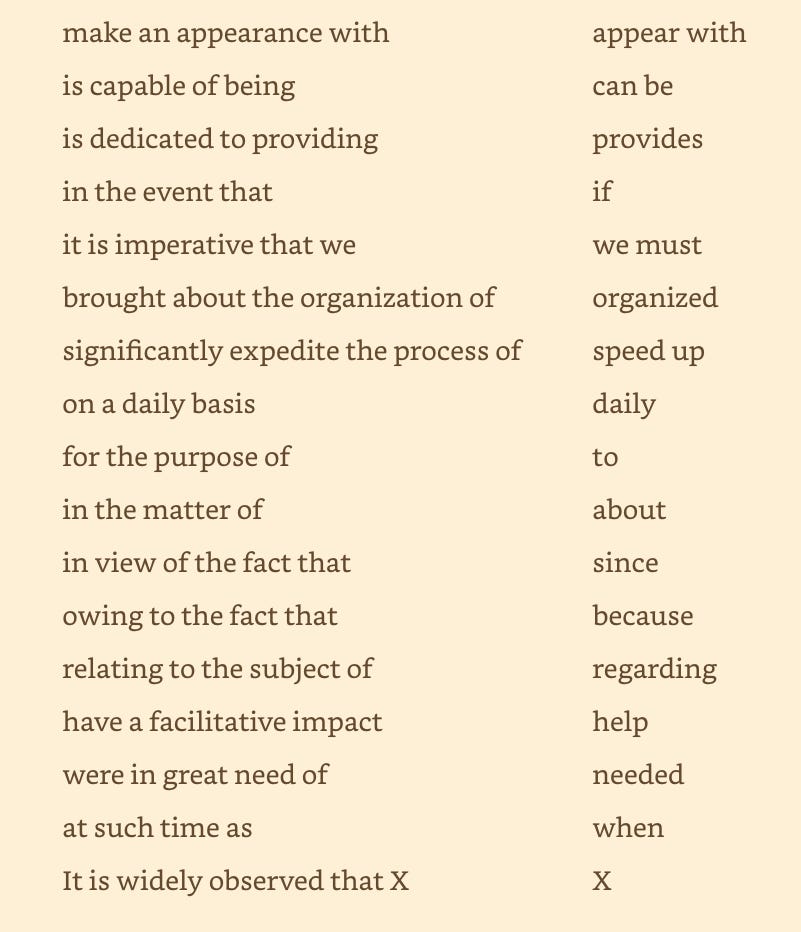
To recap, “redundancy”, the technical term for needless words, produces verbiage or bloated prose. One of the best ways to rid yourself of stylistic flaws (such as redundancy) is to expose yourself to models of excellent prose. Anyone whose staple diet is The Economist or The Atlantic is less likely to suffer from verbal diarrhoea (a la redundancy) than than someone whose meat of choice is The News or DAWN.